
What a conversion-ready landing page needs before you turn on ads
Paid campaigns amplify what already exists on the page. If the offer is vague, proof is thin, the form breaks on mobile or events are not firing, more budget mainly produces more expensive learning, not more leads.
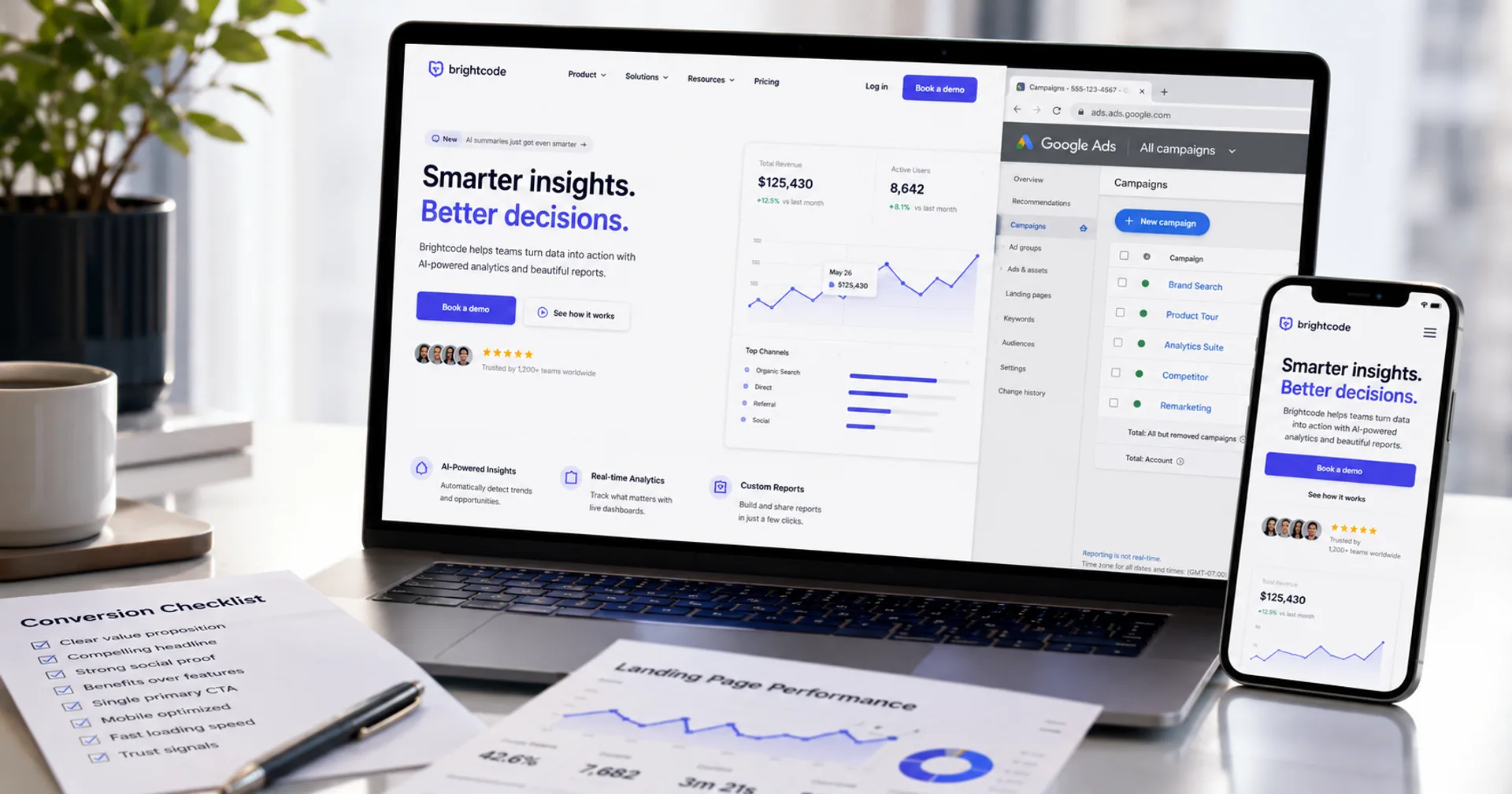
The direct answer
A conversion-ready landing page states one offer for one audience, proves credibility above the fold, loads quickly on mobile, tracks the primary conversion event reliably and removes competing navigation that leaks paid clicks. Turn on ads only after those five conditions pass manual QA on real devices, not after the design looks approved in Figma.
Landing page before ads work is not cosmetic. It is the difference between scaling spend with predictable cost per enquiry and resetting campaigns every month because the page, the form or the thank-you flow changed without updating tags.
Treat readiness as a gate, not a vibe. Marketing, web and sales should sign the same checklist, offer, proof, form, tracking, speed, before any channel budget increases.
When a dedicated landing page beats your homepage
Send paid traffic to a dedicated landing page when the campaign promotes a single outcome: audit request, demo booking, quote, download or event registration. Homepages serve many intents; ads do not. Matching message, headline and CTA to the ad copy improves quality score and conversion rate because visitors do not have to infer relevance.
Use your homepage when brand search or broad remarketing already targets people who know you and expect the full site experience, and when that homepage is genuinely conversion-oriented, not a portfolio carousel with six equal CTAs.
Use a hybrid only when tracking is unified: campaign landing pages for cold acquisition, homepage for warm audiences, with UTM discipline so reporting stays honest.
When fixing the homepage is enough
If organic and direct traffic already convert on the homepage at an acceptable rate, and paid spend is modest, a full landing page programme may be premature. Fix hero clarity, proof placement, form friction and speed first.
If your product is inherently multi-offer, marketplace, broad agency, platform with several modules, a single landing page per campaign is still usually worth it. The homepage cannot carry six ad angles without dilution.
Pre-launch checklist
Area | Ready when… | Common gap |
|---|---|---|
Offer clarity | Headline states outcome and audience in plain language | Taglines that sound clever but do not say what you sell |
Proof | Logos, reviews, cases or credentials visible without scrolling far | Proof buried below long feature lists |
Speed | Mobile LCP and interaction feel snappy on 4G-class connections | Heavy hero video, unoptimised images, tag bloat |
Form / checkout | Primary CTA works on mobile; validation messages are clear | Multi-step forms with no progress indicator |
Tracking | Primary conversion event fires once; test leads excluded | Duplicate events, missing thank-you page trigger |
Distraction | Navigation trimmed or single-purpose layout | Full site menu sending paid clicks to careers blog |
Post-submit | Thank-you page or modal confirms next step | Silent redirect to homepage with no confirmation |
Policy fit | Ad platform policies met for claims, data collection | Unsubstantiated superlatives, missing privacy link near form |
Five questions before you increase ad spend
Weak answers to the first three are page problems. Weak answers to the fourth are measurement problems, fix both before scaling. A weak answer to the fifth is a business problem; ads will not fix it.
Run these questions with whoever owns sales follow-up, not only marketing. Landing pages fail in handoff as often as in design.
Document answers in a one-page brief attached to the campaign: audience, offer, proof type, primary CTA, excluded navigation and success metric. That brief becomes the QA script when someone requests a "small copy tweak" the day before launch.
- Can a stranger explain your offer after five seconds on the page?
- Is there one primary action, and is it obvious on a phone screen?
- Does proof match the audience the ad targets (industry, geography, problem)?
- Have you submitted a test lead and seen it in CRM, email and ad platform events?
- If conversion rate doubled, could sales or operations handle the volume?
Mistakes that burn budget quietly
Sending traffic to a page that shares the main site navigation so visitors read about culture and careers instead of enquiring. Paid clicks are not free exploration budget.
Launching before mobile form QA. A broken date picker or country field on iOS destroys conversion on the traffic slice you pay most to reach.
Changing page URL or form fields after campaigns learn without updating events. Platforms optimise on history; structural changes reset learning.
Copy that matches the ad but offers no proof for a cold audience. Click-through rate can look fine while conversion rate collapses.
Multiple equally prominent CTAs, demo, call, brochure, newsletter, on a page meant to drive one action. Pick one primary; demote or remove the rest for paid variants.
Ignoring page speed because "we will optimise later." Later usually means after a month of inflated CPC. Speed work belongs in the website development scope before media, not after.
Reusing brand campaign creative on a page whose headline targets a different keyword set. Visual consistency matters; message match matters more for conversion.
Skipping legal and accessibility checks, contrast, form labels, cookie consent near tracking scripts, because "it is only a landing page." Ad platforms and regulators still apply; fixes after launch disrupt tracking history.
What to do next
Audit your top campaign destination URL against the table above on a phone you do not normally use for work. Screenshot failures; fix in priority order: offer, proof, form, tracking, speed.
Request a free website audit if you want a structured review of conversion paths, Core Web Vitals and tracking readiness on your live URL.
When you need landing pages built or rebuilt to match campaigns, our marketing and ads work pairs page structure, event setup and creative direction so spend is not sent to a broken funnel.
For broader site structure that supports SEO and paid together. Read SEO content structure for service businesses or contact with your campaign URL and target CPL.
Keep a living QA doc per campaign landing page. When copy, forms or tracking change, rerun the checklist, ads do not forgive drift.
Continue reading
Recent articles
Build·12 September 2026·3 min
What website development actually costs in India
Realistic website development cost ranges in India for 2026 — brochure, WordPress, Next.js and service sites, plus what moves the price up or down.
Build·11 September 2026·4 min
What to look for in a website development company in Delhi NCR
A practical guide to choosing a website development company in Delhi NCR: scope, stack, portfolio, process and red flags before you sign.
Build·11 September 2026·9 min
Next.js, WordPress, Shopify, and WooCommerce: How to Choose the Right Platform for Your Next Build
Compare Next.js, WordPress, Shopify, and WooCommerce for rebuilds and new sites, with use cases, tradeoffs, SEO, performance, and support.
Ready to turn on ads, or already burning budget?
Share your landing URL for a free audit. We will flag offer clarity, proof, speed, form and tracking gaps before you scale spend.