
SEO content structure for service businesses
Service sites rank when page hierarchy mirrors how buyers search: clear hub pages, specific service spokes, proof that matches each offer, and internal links that show which pages matter, not when every keyword gets a thin duplicate landing page.
The direct answer
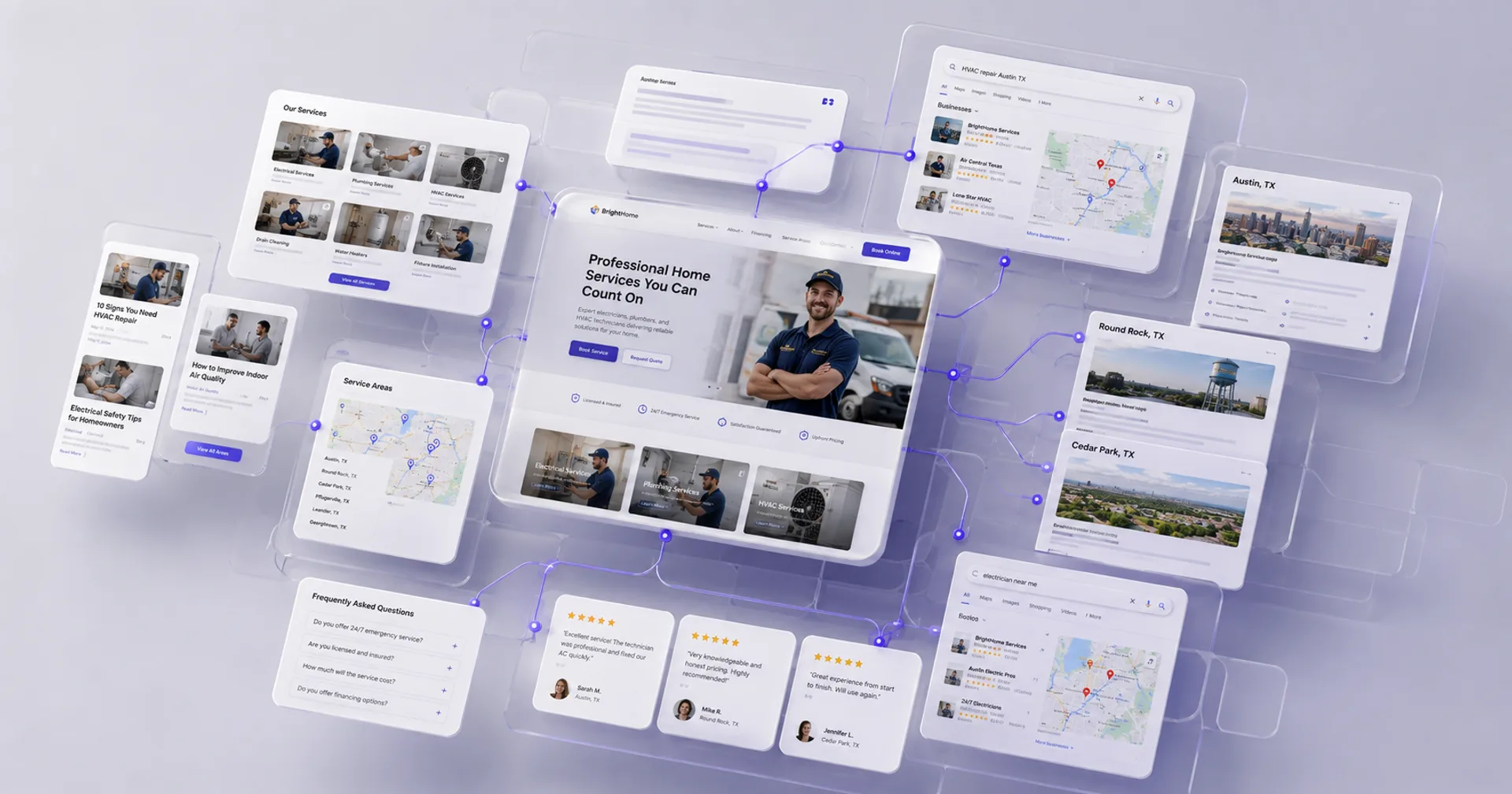
SEO content structure for a service business means organising pages into a small set of pillar hubs (what you do), detailed service spokes (who it is for and how it works), proof and FAQ layers (why trust you), and conversion paths (what to do next), connected by intentional internal links and consistent metadata templates. Search engines and AI systems infer authority from that clarity; visitors convert when the same structure answers their questions in order.
Structure is not word count. A concise service spoke that covers scope, process, outcomes and objections beats a long page that repeats the homepage introduction.
AI search surfaces amplify structured sites: definitional opening paragraphs, comparison tables and FAQ blocks give external systems extractable answers tied to your domain, but only when they match visible, accurate page content.
When a pillar-and-spoke model fits
Use pillar-and-spoke when you offer multiple related services under one brand: web development, SEO, ads, hosting, design, migration. Each spoke targets a distinct search intent; the hub prevents cannibalisation by linking outward with descriptive anchors instead of competing for the same head term.
It fits when sales cycles are consultative, buyers compare providers. Read proof, then enquire. Structure guides them through understanding, trust and action without relying on a single homepage paragraph.
It also supports GEO citability: definitional blocks, comparison tables and FAQ sections on spokes give AI systems quotable passages tied to a specific service, not generic agency copy.
When a flatter site is acceptable
Very small firms with one primary offer and one geography sometimes need only a strong homepage, a services summary, proof and contact, plus a handful of supporting articles. Adding ten spokes before you can maintain three well is worse than depth on essentials.
If paid search carries most qualified demand, structure still matters for Quality Score and landing page relevance, but organic pillar planning can stay lighter until editorial capacity grows.
Structural elements compared
Element | Purpose | Typical mistake |
|---|---|---|
Services hub | Orient visitors and consolidate internal PageRank | Keyword-stuffed list with no hierarchy |
Service spoke | Match commercial intent for one offer | Duplicate homepage copy with city swaps |
Proof blocks | Support claims with cases, reviews, logos | One generic testimonial on every page |
FAQ section | Capture long-tail questions; eligible for rich results | FAQs copied across pages with no unique answers |
Insights / articles | Earn informational traffic; link to spokes | Teasers that never link to services |
Conversion CTA | Single clear next step per page type | Every section ending with a different button label |
Schema | Clarify entities: Organization, Service, FAQ | Plugin defaults that do not match visible content |
Five questions to shape your content map
Answer on a whiteboard before writing net-new copy. Most service sites need reorganisation and internal linking more than they need fifty blog posts.
Map primary and secondary keywords to spokes honestly, one primary intent per URL. If two pages target the same intent, merge or differentiate sharply.
Assign an owner for each hub and spoke in your CMS or content calendar. Orphan pages, published once, never updated, drift out of alignment with how you actually sell.
- What are the three to nine services you actually sell and staff today, not aspirational lines on a pitch deck?
- For each service, what question does the buyer ask first, second and last before enquiring?
- Which pages already earn impressions in Search Console but fail to convert, structure or copy problem?
- Where does proof differ by service, and do you have cases that match each spoke?
- Which internal links would help a new visitor reach a conversion page in three clicks or fewer?
How internal links should work
Hub pages link down to every active spoke with descriptive anchor text, not "learn more" repeated twelve times. Spokes link up to the hub, sideways to related services and to proof that matches the offer.
Insights articles should link to the spoke they support, not only to contact. Informational content earns trust; service spokes convert it.
Footer and navigation menus reinforce hierarchy but do not replace contextual links in body copy. Contextual links carry clearer semantic signals for search and help visitors who land mid-site.
Mistakes that limit rankings and AI visibility
Location pages that duplicate the same service copy with city names swapped. Search systems treat undifferentiated templates as low value.
Blog posts that never link to relevant service spokes, informational traffic arrives and leaves without a path to enquiry.
Service pages without process, deliverables or scope boundaries, they read as marketing fluff and do not answer "what am I buying?"
FAQ blocks pasted site-wide with identical answers, which dilutes uniqueness and can trigger quality filters.
Metadata written per page by hand without templates, titles drift, brand suffixes disappear, CTR suffers at scale.
Schema added via plugins that reference services you do not visibly offer on the page. Mismatch erodes trust signals.
Treating SEO structure as finished at launch. New offers, cases and search data should update the map quarterly.
What to do next
Export Search Console queries and landing pages. Mark which URLs should be hubs, spokes, proof or candidates for merge. Fix internal links on the top twenty URLs by impressions first.
If technical foundations, sitemap, canonicals, CWV, redirect hygiene, are weak, structure alone will not hold. Pair content mapping with SEO and performance fixes in code and CMS templates.
When rebuilding hierarchy as part of a replatform, align with our website migration checklist so URL changes do not erase progress.
Request a free website audit for a prioritised view of structure, speed and indexation on your live site, or contact with your service list and top three growth goals.
Continue reading
Recent articles
Build·12 September 2026·3 min
What website development actually costs in India
Realistic website development cost ranges in India for 2026 — brochure, WordPress, Next.js and service sites, plus what moves the price up or down.

Build·11 September 2026·4 min
What to look for in a website development company in Delhi NCR
A practical guide to choosing a website development company in Delhi NCR: scope, stack, portfolio, process and red flags before you sign.

Build·11 September 2026·9 min
Next.js, WordPress, Shopify, and WooCommerce: How to Choose the Right Platform for Your Next Build
Compare Next.js, WordPress, Shopify, and WooCommerce for rebuilds and new sites, with use cases, tradeoffs, SEO, performance, and support.
Structure sound right but rankings flat?
Send your URL for a free audit. We will map hub-and-spoke gaps, internal links and technical blockers, then recommend fix order.